

Many organizations invest in security tools and certifications without a clear strategy connecting them. The result is overlapping products, gaps nobody owns and difficulty explaining to the board whether the organization is becoming more secure. A cybersecurity strategy fixes this by aligning security with business objectives and regulatory requirements.
This step-by-step guide explains what a comprehensive cybersecurity strategy includes, why it matters now, and how to develop and implement one that leadership will support and teams can deliver.
What is a cybersecurity strategy?
A cybersecurity strategy is a leadership-approved plan that defines how an organization will protect its information, systems and services over the next two to three years. It differs from related documents:
| Document | Purpose | Typical owner |
|---|---|---|
| Cybersecurity strategy | Sets direction, priorities, target state and investment over several years | CISO or vCISO, approved by leadership and the board |
| Security program and roadmap | Turns the strategy into funded projects and milestones | CISO and program managers |
| Policies and standards | Define the rules people and systems must follow | Security, risk and compliance teams |
| Procedures | Explain how specific tasks are carried out | Operational teams |
Why every organization needs a cybersecurity strategy now

| Finding | Figure | Source |
|---|---|---|
| Global average cost of a data breach (2026) | $4.99 million, up 12% | IBM Cost of a Data Breach 2026 |
| Average cost of a data breach in the Middle East (2026) | $8 million | IBM Middle East findings |
| Leaders naming AI as the biggest driver of cybersecurity change | 94% | WEF Global Cybersecurity Outlook 2026 |
| Organizations factoring geopolitically motivated attacks into risk planning | 64% | WEF, 2026 |
| Security teams reporting at least one skills gap | 95% | ISC2 Cybersecurity Workforce Study 2025 |
In the UAE, the government approved a new National Cybersecurity Strategy in 2025, and regulators in financial services, healthcare and government continue to raise expectations. A clear strategy is the best way to meet these demands without spending money in the wrong places.
How to develop and implement a cybersecurity strategy: 10 steps

1. Understand business objectives and risk appetite
Start with the business, not the technology. Which growth plans, products, markets and partnerships does security need to support? How much disruption, data loss or regulatory exposure is leadership willing to accept?
2. Identify critical assets and obligations
List the systems, data and services that matter most, and the regulations and contracts you must meet. For UAE organizations this often includes ISO 27001, the UAE PDPL, the UAE IA Standard or Dubai ISR, Central Bank of the UAE requirements, ADHICS in Abu Dhabi healthcare and client demands such as SOC 2.
3. Assess your current state
Measure current capabilities against a recognized framework such as the NIST Cybersecurity Framework 2.0, whose six functions are Govern, Identify, Protect, Detect, Respond and Recover. An independent security assessment gives an objective baseline. Our article on security assessment frameworks for hybrid environments explains the approach.
4. Understand the threats you face
Identify the attackers most likely to target your sector and region, from fraudsters and ransomware groups to state-sponsored actors, and the techniques they use. Our article on advanced persistent threats describes the most sophisticated of these.
5. Define the target state
Decide what "good" looks like in two to three years for each area, for example a target NIST CSF tier, certifications to achieve or maximum acceptable recovery times for critical services.
6. Build a prioritized roadmap and budget
Close the gap between the current and target state through a sequence of initiatives. Start with quick wins that reduce risk significantly at low cost, then plan larger projects over 12 to 36 months. Tie each initiative to the risks it reduces so leadership can see the value of the investment.
7. Establish governance and ownership
Agree who owns the strategy, how progress is reported and how decisions are escalated. If you do not have a full-time CISO, a virtual CISO can provide this leadership.
8. Implement the core controls first
Whatever your size, a small set of controls prevents most common attacks: multi-factor authentication, endpoint detection and response, patching, secure backups, email security, logging and monitoring, and least-privilege access. The CIS Controls Implementation Group 1 is a good reference for this baseline.
9. Invest in people and culture
Phishing, voice phishing and social engineering remain leading causes of breaches. Practical, regular awareness training and clear reporting routes make employees part of the defense.
10. Measure, report and adapt
Track a small set of meaningful metrics, report them to leadership in business terms, and review the strategy every year or after major changes such as an acquisition, a new regulation or a significant incident.
Turning strategy into initiatives

The table below shows how a strategy can map to the NIST CSF 2.0 functions:
| Function | Example strategic initiatives |
|---|---|
| Govern | Security strategy and policies, risk appetite, roles, board reporting, supplier security requirements, AI governance |
| Identify | Asset and data inventory, risk assessments, data classification, regulatory mapping |
| Protect | MFA and privileged access, Zero Trust segmentation, encryption, secure configuration, awareness training |
| Detect | Centralized logging, SIEM and SOC monitoring, threat hunting, vulnerability management |
| Respond | Incident response plan, playbooks, regulatory notification, tabletop exercises |
| Recover | Immutable backups, disaster recovery testing, business continuity, lessons learned |
For specific initiatives, see our articles on Zero Trust architecture, cloud security posture management and AI-powered incident response.
Common mistakes to avoid
Starting with tools. Buying products before defining the problem leads to overlap and gaps.
Treating compliance as the strategy. Certifications are evidence of good practice, not a substitute for managing real risks.
No business ownership. Security led only by IT rarely gets the funding or support it needs.
Too many priorities. A roadmap with 50 equal priorities has none. Focus on the few initiatives that reduce the most risk.
Never revisiting the plan. Threats, regulations and the business change every year, and the strategy must change with them.
A cybersecurity strategy for smaller organizations
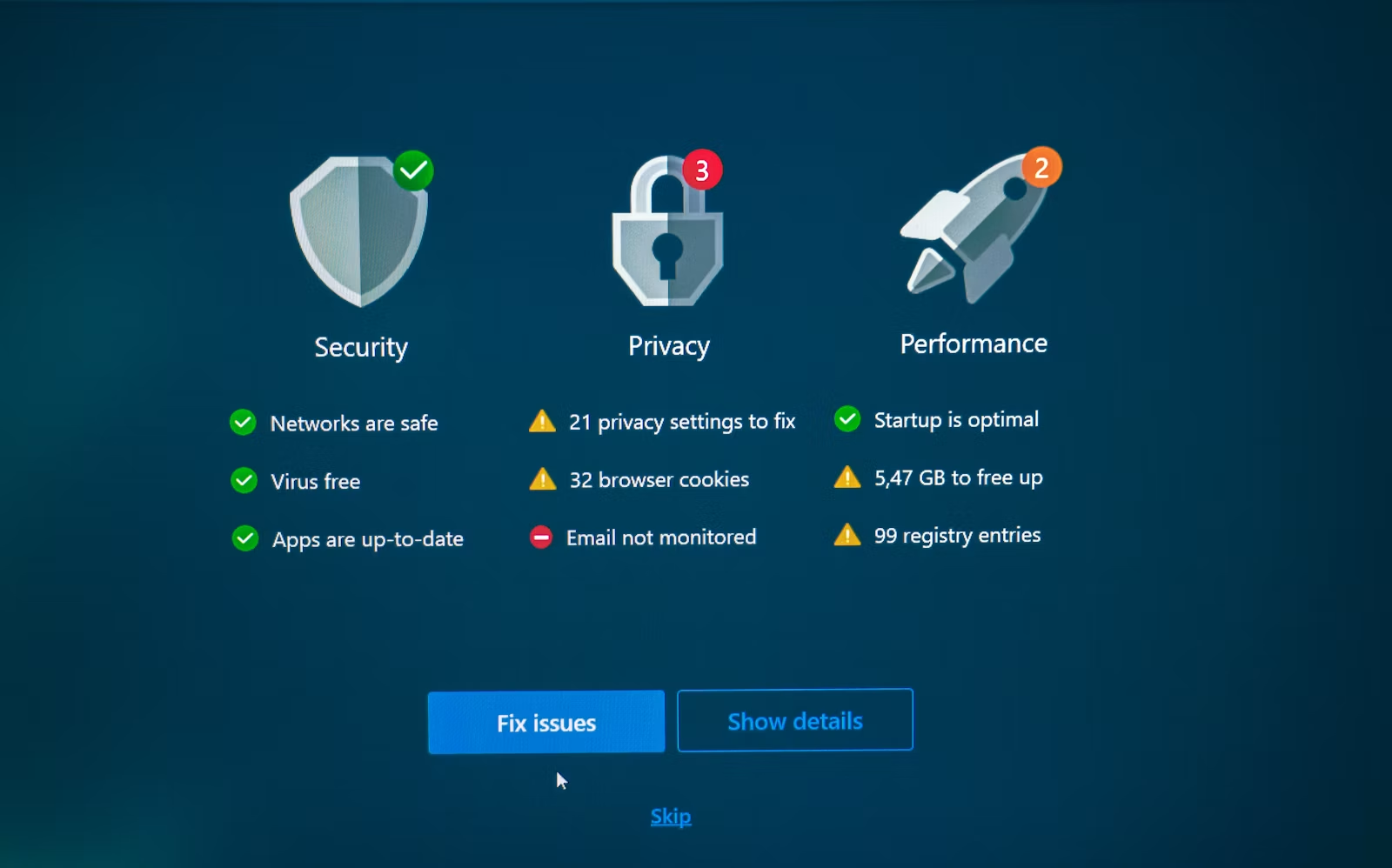
A strategy does not need to be long or expensive. For small and medium-sized businesses, a short document that names the critical assets, the top risks, the core controls to implement in the next 12 months and who is responsible is far better than nothing. Our article on why SMEs still shy away from cybersecurity looks at the common barriers and how to overcome them.
How Intello helps build and implement cybersecurity strategies
Intello helps organizations across the UAE develop cybersecurity strategies that support their business objectives and meet regulatory requirements. We assess your current state, define the target state and roadmap, and support implementation through our cybersecurity services, IT governance, risk and compliance and virtual CISO offerings.
Talk to our cybersecurity strategy team or book a free security assessment.
Frequently asked questions
What is a cybersecurity strategy?
A cybersecurity strategy is a leadership-approved plan that defines how an organization will protect its information, systems and services over the next two to three years, including priorities, target state, roadmap, budget and ownership.
What are the steps to build a cybersecurity strategy?
Understand business objectives and risk appetite, identify critical assets and obligations, assess the current state, analyze threats, define the target state, build a prioritized roadmap, set up governance, implement core controls, invest in people and measure progress.
Which framework should a cybersecurity strategy use?
Many organizations use NIST Cybersecurity Framework 2.0 to structure the strategy, ISO 27001 for the management system and the CIS Controls for a prioritized technical baseline. UAE organizations should also map local requirements such as the UAE IA Standard or Dubai ISR.
How often should a cybersecurity strategy be updated?
Review it at least once a year, and after major changes such as an acquisition, entry into a new market, new regulations or a significant security incident.
Who should own the cybersecurity strategy?
A CISO or virtual CISO usually develops and leads it, but it should be approved by senior leadership and the board, who are accountable for cyber risk.
Do small businesses need a cybersecurity strategy?
Yes. A short, practical strategy that names critical assets, top risks, core controls and responsibilities helps small businesses spend limited budgets where they matter most.